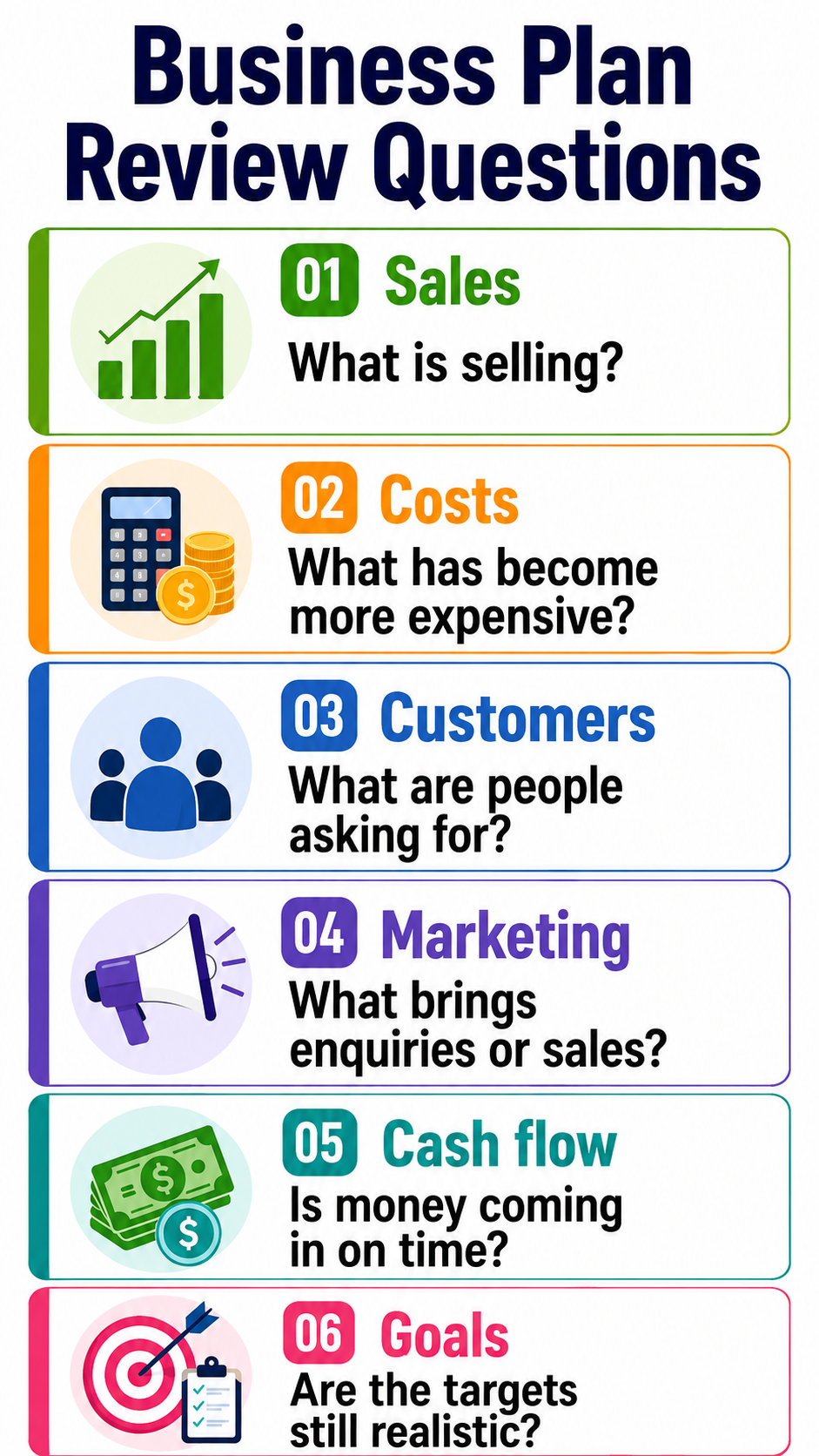
A useful business plan review does not have to be complicated. The important thing is to use real information. Do not rely only on gut feeling. Look at your sales, expenses, cash flow, customer feedback, marketing results, stock levels, enquiries and payments. The purpose of the review is to compare what you planned with what is actually happening in the business. This helps you see what is working, what is not working and what needs to change.
Start with your sales
Are your sales growing, falling or staying the same? Are you selling enough to cover your costs? Which products or services sell best? Which ones take a lot of time but bring in little profit?
It is useful to look beyond the final sales figure. If your sales are lower than expected, ask why. Are you getting enough enquiries? Are people asking for quotes but not buying? Are your prices too high, too low or unclear? Are customers choosing competitors? Are you reaching the right people?
For example, if your goal was to increase sales by R8,000 per month, you should also look at your leads, conversion rates, pricing and marketing activity. If you are not reaching the target, the problem may be weak sales methods, poor lead sources, pricing problems or marketing that is not reaching the right customers.
Sales are one of the first things to check.
Check your costs and cash flow
Next, check your expenses. Have your costs increased? Are you paying more for stock, transport, electricity, rent, data, packaging, wages or supplier deliveries?
Cash flow is just as important as profit. You may be making sales, but if customers pay late or expenses are due before money comes in, the business can still struggle. Check whether money is coming in quickly enough to cover your expenses. A regular review helps you decide whether you need to adjust prices, negotiate with suppliers, reduce waste, change payment terms or follow up more quickly on unpaid accounts.
Small increases in costs can reduce your profit if you do not notice them early.
Listen to your customers
Customers may show you that they want a different size, package, price, delivery option, payment method or service level. Ask yourself what customers are repeatedly requesting. Are they asking for cheaper options, faster delivery, smaller quantities, online booking, WhatsApp ordering or after-sales support? Are they complaining about the same issue? Are they buying one product but ignoring another? This information can help you improve your offer before you spend more money in the wrong direction.
Customer feedback is one of the most valuable parts of a business plan review.
Review your marketing
Marketing should not only be judged by how many people see your posts or adverts. For example, a Facebook page may have many likes but few buyers. A WhatsApp group may bring fewer people but better sales. A local referral may be more valuable than a paid advert. A market stall may help you test demand even if it does not bring large profits immediately. If you use social media, check engagement as well as followers. Comments, shares, enquiries and actual sales matter more than numbers that only look impressive.


You need to know whether your marketing is bringing enquiries, customers and sales.
Review your goals
A new business may focus on getting regular customers. A more established business may focus on increasing profit, improving systems, adding staff, buying equipment or applying for funding.When you review your goals, ask whether they are still realistic. You may need to make them smaller, more specific or more practical. You may also need to change your strategy if your original goal is no longer suitable.
Regular review keeps you accountable. It helps you ask: Did I reach my target? Were my costs higher than expected? Which products worked best? Which marketing methods brought results? Which customers paid on time? What should I stop doing? What should I do more of?
Your goals should still make sense for your current stage of business.